Paula Meehan reads her poem "The Pattern"
Wednesday, 14 October 2015


Monday, 12 October 2015
Launch of the Hibernian Writers Anthology

20 October 2015 19.00
Teachers’ Club 36 Parnell Sq. Dublin
The collection will be launched by the poet and publisher Macdara Woods with some reading from the contributors. All welcome.
Contributors:
MARK BAKER • GERALDINE CLARKSON • KEVIN CONROY • EVAN COSTIGAN • SINÉAD COTTER • PHILIP CUMMINS • MAURICE DEVITT • KIERAN FUREY • DONAL GORDON • ELEANOR HOOKER • BRIAN KIRK • SUSAN LINDSAY • PATRICK MADDOCK • MYRA MCAULIFFE • AFRIC MCGLINCHEY • GILES NEWINGTON • BARBARA O’SHEA • MAEVE O’SULLIVAN • LEEANNE QUINN • JANE ROBINSON • JOHN SAUNDERS • ANNETTE SKADE • BREDA WALL RYAN
Published by Alba Publishing
Thursday, 8 October 2015
Baileborough Poetry Festival and Workshop
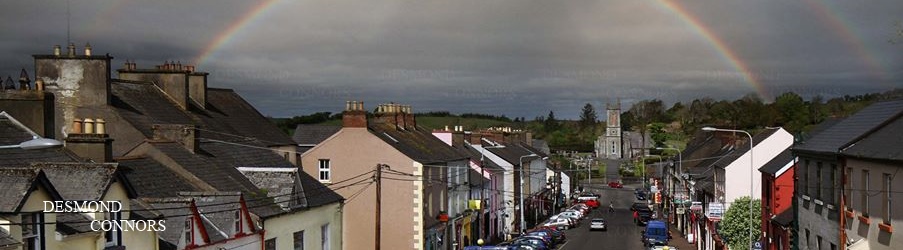
Bailieborough Poetry Festival 2015 – Programme of events
Friday 9th October: (Murtagh’s Lounge, Main St.)
18.30 Official launch of “Behind the Lines” Anthology by LitLab. Introduced by Myles Dungan and Julia Rice O’Dea.
19.45 A Wilde Night by Patrick Walsh.
20.00 Poetry reading by Michael Farry.
21.00 Open mic.
Saturday 10th October:
10.00 Poetry workshop* – Kate Dempsey. (Bailieborough Library)
14.00 Competition prize giving – Michael Farry & Honor Duff (Bailieborough Library)
14.00 – 17.00 Special poetry-themed afternoon tea in Bailie Hotel on Main Street.
16.00 Literary walking tour of Bailieborough with John Ed Sheanon- (starts at Bailieborough Library)
19.00 Open Mic. Featuring writing/ arts groups. – (Murtagh’s Lounge)
20.00 Poems and stories by Patsy McDermott – (Murtagh’s Lounge)
21.00 Poetry reading by Tony Curtis.
Interview with writer, Roisin Meaney

Hi Roisin and welcome to writing.ie. How did you first get into writing?
Short answer: I entered a competition when I was 18. Part of the entry involved finishing a sentence in 10 words or less. The first part of the sentence was "I would like to win a Ford Fiesta because.....' I ended it with '....my father won't let me drive his.' I won a Ford Fiesta.
Long answer: When I left school I went to Training College (just after winning the car) and in due course I qualified as a primary teacher. After 9 years of teaching I felt like taking a break but didn't know what to do. A cousin suggested I try to get a job in advertising 'because you're good with words.' He was referring to all the other sentences I'd finished after winning the Ford Fiesta, which had resulted in my winning a lot more: two holidays, a hotel break, a bicycle, a watch, a sweater, a dairy foods hamper, a set of crockery and enough air miles to fly to San Francisco and back. I took my cousin's advice and wangled a job as advertising copywriter in an agency in London. I worked there happily for three years and then returned to the classroom. While I was in London I began to think about writing a book, but it was to be another decade before I took another career break and flew - yes, to San Francisco (remember the air miles?) where a brother of mine lived. There I wrote my first book, not having much of a clue about what I was doing, just telling a story and hoping for the best. It ended up winning a 'Write a Bestseller' competition and was published by Tivoli Books in 2004 as The Daisy Picker.
What a great story in itself! How does writing full time compare to teaching?
Impossible to compare, although I did love teaching, almost as much as I love writing. But being a full time writer brings so much flexibility that teaching couldn't offer, like being able to work in my pjs - even to bring the laptop to bed for the day if I feel like it, or relocating to wherever I want to write - anywhere the sun is shining, or setting my own working hours - my insomniac tendencies often have me awake before 5.00am, so my working day could start then and finish by lunchtime.
One thing full time writing doesn't deliver is the company of children, which of course I had in spades during my teaching days, so to compensate I tell stories once a month to 'smallies' in my local library, and I also visit schools and libraries and chat to kiddies about life as a writer. Teaching had a lot to recommend it; every day I experienced the joy of having a gang of little ones to nurture and look after, but on balance, I'm happier as a writer, and feel very blessed to be making my living doing what I love most.
Where do you do your writing?

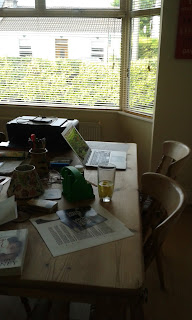


Here's where I write: the kitchen table, in all its higgledy-piggledy glory. (The book on the table was pure chance - I'm sending it off to someone today.)
I know you sometimes head off with your laptop. Does that help your writing, do you think? Or just your headspace?
I think it helps with both, Kate. It’s good to be away from distractions of family and friends - and a bonus if wherever I'm heading doesn't have wi-fi! - and I always feel the writing is turned up a notch when the surroundings are unfamiliar, and my routine as a result somewhat changed. I love going somewhere sunny, not because I'll be lying out in it, but even looking out at a blue sky does me good, and I feel perks up the writing too.
Do you have a writing group or a reader?
No writing group, no reader. I'm a bit precious in that respect, hate showing it to anyone until I surrender the completed first draft to my editor and agent simultaneously. I'd be iffy about letting a group read it, in case they all came back with different verdicts - and I'm not sure that I'd trust the judgement of a single reader either.... As it is, my editor and agent each give me feedback, so I have two sets of notes to work on for draft two, which I feel is plenty.
I guess your editor and your agent are your readers then! How did you get this agent?
My agent, Sallyanne Sweeney of Mulcahy Associates in London, was recommended to me by Vanessa McLoughlin, the brains behind www.writing.ie which is a wonderful go-to for all things writerly.
Didn’t you have an agent before her? I'm interested in how you got your first agent.
My first agent came on board after I got the publication deal, so I'm not sure that'll be of any use to any writers out there! I won the two-book deal and then I thought 'I'd better get an agent' and I emailed Faith O'Grady, who had recently taken on Judi Curtin, a friend of mine who'd finished her first novel a few months before mine. Faith took me on, and handled my first six or seven books, after which I felt it was time to ring the changes - I wanted a London-based agent because I thought it might put me in a better position with the UK market, and Sallyanne is actually Irish so knows the Irish market well too, which is ideal.
What tips would you have for writers with a novel in progress?
Best tip I think I could give is KEEP AT IT. If I had a cent for everyone I've met since I started writing who said 'I'd love to write a book if I had the time' I'd be rich. If anyone REALLY wants to write a book, they'll find the time, and they'll keep on finding the time every day until the book is written. Roddy Doyle wrote Paddy Clarke Ha Ha Ha when he had a full time teaching job AND a toddler or two on the scene. I have to discipline myself all the time to keep writing when a book is in progress. Mind you, having a deadline from a publisher definitely helps!
Another tip would be to read. I firmly believe you can't be a writer unless you're an avid reader - genre immaterial - but amazingly, I meet people who don't read but who want to write. Can't understand it.
What have you read recently that you'd recommend?
I enjoyed Elizabeth is Missing by Emma Healey, and A God in Ruins by Kate Atkinson, and The Green Road by Ann Enright - shades of the wonderful Let the Great World Spin, I thought.
I enjoyed Elizabeth is missing too. Kate Atkinson is on my list. I've read everything she's written.
I'm a huge fan of Kate Atkinson, and did enjoy A God in Ruins, but I'd have to say I preferred Life After Life, which I thought was stupendously good.
All women. Do you find yourself discriminated against much or pigeonholed as a woman writer?
Discriminated/pigeonholed.....hmmmm, probably pigeonholed more as a chick lit author than a female author, thanks in no small part to the book covers, which are NOT of my doing! In fairness I'm not writing literary fiction, but I'd love if there was a middle ground between the two.... My readers are predominantly female, of course, but the odd male crops up from time to time in my inbox! Can't say I've experienced discrimination, no. (Although I sometimes suspect I'd have better luck getting publicity if I lived in Dublin and was around for all the bookish events that take place there.)
Yes, there’s a definite flavour of book covers that scream chick lit. Can you give us one or two pieces of advice you wish you'd known when you were starting out?
- If you get a publishing deal, your publishers will choose your book covers, not you. The sooner you realise this, the happier you'll be. They also write the blurbs. I've learned to accept this. It took a while.
- You need to put almost as much energy into marketing your books as you do in writing them, even if there is a dedicated marketing person working on your behalf too. Someone who has not written a book will NEVER be as invested in it as the person who wrote it. You need to become a publicity slut, and befriend journalists, booksellers, librarians and anyone else who can help to sell copies, or spread the word about your books. You also need to shout about the books (in a nice way) on social media.
I think you do a great job on social media.
Social media - the bane of my life, spend far too much time on it! But it is good to get the word out.....
Do you also write short stories? What about poetry? Plays? ever dabbled?
Never tried short stories, wouldn't know where to start! Poetry ditto - a mystery to me! I have thought about writing a play or a screenplay, have done a few courses/workshops, wrote an episode a few years ago of a TV drama I was planning, an adaptation of one of my novels.....but my agent showed it to one or two who weren't interested, and the momentum was lost. Might resurrect it sometime.
You have a good ear for dialogue. Maybe a radio play would suit you? With a new novel, how do you start? Do you start with a plan? Know where you are going from the start? Or only a rough destination and strong characters?
I start with a plan, but the actual plot would be fairly sketchy - deliberately, so I have leeway. I'd also write bios for the main characters, and a bit of background for the story.
How much of the next book would you like have done before your current book is launched?
My new book, I’ll be Home for Christmas, is launched in mid October by which time I hope to have made some inroads - 20K words or so - into the next, but it varies. First draft takes between six and eight months generally, depending on how much research I need to do.
Anyway, if you had to choose one book out of your twelve (wow, prolific!) to represent you, which would it be and why?
Oooh, tough question, like asking a mammy to choose her favourite child - but if I was tortured to within an inch of my life and made to pick one it would probably be Something in Common (2014). It was the one that caused me the most grief in the making, and the one I was most proud of in the end - and maybe that's how mammies feel about the child they secretly favour!
Thanks very much, Roisin. Roisin Meaney’s new book I’ll be Home for Christmas is due out from Hachette on 15th October. Look out for some early festivities.

- I'll be Home for Christmas

Tuesday, 6 October 2015
Interview with poet Doireann Ní Ghríofa

Welcome Doireann Ní Ghríofa to emergingwriter.
1st question: How did you first get into poetry?
1st question: How did you first get into poetry?
A wonderful anthology was gifted to me
in my teenage years. Edited by Niall McMonagle, it was titled 'Real
Cool - Poems to Grow Up With' and the cover featured a teenager
wearing the sort of tall Doc boots that I would have coveted in my grungey days
of the mid-1990s.

The selection leant towards Irish poets: Paul Muldoon,
Rita-Ann Higgins, Paul Durcan, Brendan Kennelly, but it was here too that
I first read poems like Sharon Olds's 'The Moment', Denise Levertov's 'Leaving Forever' and Adrienne Rich's 'Aunt Jennifer's Tigers'. A particular poem that blew my
teenage mind was 'The Pattern' by Paula Meehan, a poem that I am still in awe
of. I wasn't writing poems yet but with this book, my mind was split open to
the wonders of poetry. Beware giving this book to teenagers - it's a gateway
drug.
I’m not familiar with Real Cool. I’ll
have to look up some of those poems. Well chosen by Niall then. So what
happened next? Did you just start writing away for yourself? When did you start
sharing?
I didn't begin to write for many, many years after that, not until after I'd finished college, gotten a job, had my first child. I was a voracious reader all along though, and I think that really tunes the ear to language. I was 28 writing my first poem and like many people, for me, it was grief that sparked that initial writing impulse.
I didn't begin to write for many, many years after that, not until after I'd finished college, gotten a job, had my first child. I was a voracious reader all along though, and I think that really tunes the ear to language. I was 28 writing my first poem and like many people, for me, it was grief that sparked that initial writing impulse.
I began to write every day and before
long I had a poem or two published in journals. Then I was shortlisted for the
Emerging Writer Award at the Oireachtas literary awards, which was a great
boost. I kept writing daily until I had a manuscript and then I sent it to the
publisher of my favourite poet, Biddy Jenkinson (Coiscéim), fully expecting a
rejection. I was thrilled when the editor, Pádraig Ó Snodaigh, rang me to
accept my work and that manuscript became my first book of poems, Résheoid. Another book, Dúlasair and
a bilingual chapbook, A Hummingbird, Your Heart from Smithereens Press followed and then I started writing in
English. Dedalus Press published Clasp,
my first book of English poems, earlier this year. At the moment I find that
poems are coming to me in Irish again...
So you started writing in Irish? How
much of your life was in Irish?
Much of my primary and secondary
education as well as my work life has been through Irish, so it was natural that
my first two books (Résheoid and Dúlasair) were both in Irish too.
Where did you grow up?
I'm a proud Clarewoman! I led a very
bookish childhood in Clare, many of my fondest memories relate to the library
in Ennis. Edna O'Brien was a writer that I would have been very aware of as I
grew up. She was often spoken about and I read her books in fascination. I
understood from a young age that this was a woman of bravery, that a life in
writing demanded both courage and grit. Not a bad lesson to learn early!
I've often wondered about the
difference when writing in two languages. Do some themes/images/memories fit
better in one language than the other? Do you write exclusively in one language
for a while and then, for whatever reason, switch?
In terms of the shift between languages
I've often wondered the same thing, but I'm afraid it's as much of a mystery to
me as it would be to anyone else. For a long time I wrote exclusively in
Irish, then I wrote bilingually (with a first draft growing simultaneously
in Irish and in English); I also spent a time writing only in English and for
the past while my poems have been only in Irish. This is more troublesome as
I've never had the privilege of a translator so writing solely in Irish means
that I'm creating a lot of translation work for myself in the future... but
self-translation is an interesting exercise, it requires me to examine my work
through a different gaze, to deconstruct and reconstruct it again.
Translation is always a challenge.
Where do you write
mostly?
I write everywhere, Kate, everywhere! I don't have a writing room, I don't even have a desk, but I'm always writing, filling the quiet little moments of each day with words. I'm of that tribe of writers who write in the spaces around small children. I write in the car doing the school run, on the sofa, in the garden, in bed before I fall asleep, whenever I get a couple of minutes alone. My favourite spot to write at the moment is the kitchen table, a moses basket with sleeping baby at my elbow. My writing time is fragmented and scattered but I make it work because I have to. I hope I'll continue to write for many years, I'm curious to see where it will take me next!
I write everywhere, Kate, everywhere! I don't have a writing room, I don't even have a desk, but I'm always writing, filling the quiet little moments of each day with words. I'm of that tribe of writers who write in the spaces around small children. I write in the car doing the school run, on the sofa, in the garden, in bed before I fall asleep, whenever I get a couple of minutes alone. My favourite spot to write at the moment is the kitchen table, a moses basket with sleeping baby at my elbow. My writing time is fragmented and scattered but I make it work because I have to. I hope I'll continue to write for many years, I'm curious to see where it will take me next!

Your first English collection Clasp has
been very well received. You have a lot of fans on my twitterfeed! How did it
come about and what has happened since?
Thanks Kate, I'm glad to hear that people are enjoying my writing.
Thanks Kate, I'm glad to hear that people are enjoying my writing.
Beginning to write poems in English was
like starting all over again in many ways: building up a record of publication
in journals, seeking feedback on my work, giving readings, etc. It took a while
to establish my work in English to a point where I had a manuscript of poems
that I thought worth submitting. By mid-2013 I felt ready and consulting my
bookshelves, I saw that many of the poets I most admire were published by
Dedalus Press - Paula Meehan, Billy Ramsell, Grace Wells, Theo Dorgan, Macdara
Woods, Jessica Traynor, Enda Wyley and so many more. My manuscript was accepted
in November that year and I was over the moon. Pat Boran at Dedalus Press is
such a wonderful editor. As a poet himself, he has a great ear for the pulse of
a poem and a very keen eye. I learned a lot through the editing process. I feel
extremely lucky to work with him; I've nothing but great things to say about
Dedalus Press! The book itself has been widely reviewed and I've been very
pleased with the response.
Clasp was only published a few months
ago, but in the meantime I've been working on new poems (many as Gaeilge so
far). I've also been focusing on a translation project, working to bring the
poetry of Caitlín Maude to a wider audience. I've translated many of her
poems and it has been both inspirational and exciting, delving into her writing
so closely. So far I've placed her poems in Poetry Ireland Review, Cyphers, Translation Ireland, Modern Poetry in
Translation and on RTE Radio One. She's a wonderful poet, and I'm very
pleased to champion her work. It's a privilege to be allowed to do so and I'm
very grateful to her family for permitting me to work with her poetry.
I don’t know anything about Caitlin
Maude or her poems. What can you tell us about her?
She was a fascinating woman, a gifted
poet, playwright, actress and sean-nós singer. She died tragically young in
1982, leaving a substantial body of Irish poems. TG4 broadcast a wonderful
documentary by Aoife Nic Cormaic several years ago which is available on
YouTube http://www.youtube.com/watch?v=clC-v_nBoCM
You have managed to get a lot of
reviews.
My only strategy with reviews is simply
to release the book into the world and cross my fingers. Whatever will be, will
be. I find that there's a lot to learn from a review, different readings of the
book can illuminate the work in a new way. Reviews are a gift (although they
can sting, and when they do it's best to suffer in silence!) Dedalus have been
brilliant in terms of distributing the book for review. I'm so grateful to each
of the newspapers and journals who chose to review my work, particularly as there
has been so much written of late on the difficulties for women writers in
having books reviewed.
Your collection was accepted in November 2013 but
published a few months ago? Is that normal?
A year and a half to two years between acceptance
and publication would be standard across most genres in publishing, as far as I
know. For me, that time was spent developing the manuscript as a whole and
strengthening individual poems, sourcing cover art, arranging the mini
book-tour around various literary festivals, etc. Time well spent. Congratulations
on your own forthcoming book!
Thanks, The Space Between is coming out with the
lovely people at Doire Press soon. It’s slow to hatch.
It sounds like you've given your book time to
mature Kate; that can only be a good thing. Doire Press have published such
vibrant collections - I particularly enjoyed 'Keeping Bees' by Dimitra Xidous and 'In a Hare's Eye' by Breda Wall Ryan. I'm looking forward to
reading 'The Space Between', I have
your chapbook from Moth Editions so I know your work well! Congratulations!
Thanks very much. OK, last question. When I was struggling to choose which poems to put in my collection and which to leave out, someone said to look at each poem, and decide that if someone selected this poem as the one to remember from the whole collection, would you be OK with it. So, which poem from Clasp would you choose to be the one you would be happy to be the only one that someone would remember?
What an interesting final question, Kate! Hmmm... I
have a soft spot for 'The Horse under the Hearth' (in The Irish Times here) It's a poem that audiences
respond very positively to both in the book itself and at readings, so it
engages on the stage as well as on the page. I absolutely love engaging with
audiences through poetry readings, it's such a pleasure, so it's vital to me
that my poems resonate in both private and public settings.
Thanks Doireann for agreeing to be interviewed. I
particularly enjoyed the sequence of Cork City poems in Clasp.
Thanks for such an interesting interview, Kate, and
the best of luck to you with 'The Space
Between'!
Clasp is available to buy online at Dedalus Press or at your favourite independent bookshop. Thoroughly recommended.

Bio:
Doireann Ní Ghríofa is a bilingual
poet, writing both in Irish and in English. Among her awards are the Ireland
Chair of Poetry Bursary 2014-2015. Her website is here.
Sunday, 4 October 2015
Interview with writer Tanya Farrelly

Hi Tanya and welcome to emergingwriter. How did you first get into writing?
As a very young child, I was an avid reader, and I guess writing was a natural progression from that. I remember writing stories when I was in primary school, and this passion continued right through secondary school, encouraged robustly by an eccentric English teacher by the name of Austin Stewart who was very much our Mr Keating from The Dead Poets' Society! He used to write comments like "potential novelist" on my short stories, and it was on his advice that I submitted and had my first story published in Woman's Way back in 1999.
How lovely to have a teacher saying things like that. Tell us a bit about your first published story.
My first published story was entitled 'Serial Lovers', which Woman's Way changed to 'Heartbreakers.' I wasn't mad about that, but was excited enough to dismiss the change as insignificant when I received a copy of the magazine in the post. I hadn't actually been told that the story was accepted. Oh - and there was a cheque, too! Much the same thing happened with my story 'Shadows' when it appeared in The Sunday Tribune. I was on a Sunday drive with my mother in Wicklow and went into the a newsagents to get the paper. I'd always gone straight to the New Irish Writing page, and this time I opened it up to find that my story was up for the Hennessy!
Up for the Hennessy! When was that?
That was in 2002, which was the year when writing really took off for me. I was shortlisted for the Francis MacManus Awards that year, too, so it was a really exciting time. I then, reluctantly, took time out from writing as I returned to college to do a degree in Literature, and then a Masters. I was working full-time and studying part-time, so I had to shelve my writing for four years! When I finished the MA in 2007, I decided that I'd had enough of studying other people's work. It turned out NOT to be the end of academia though - when the recession hit in 2009 and my teaching hours were cut, I took the opportunity to do a PhD - but this time my studies were in Creative and Critical Writing. I wrote a novel as part of that doctorate, which I'm currently re-editing!
Why did you return to college for your degree? You say reluctantly. What was the urge?
I was not reluctant to return to college, but reluctant to stop writing.
At that time, I was a member of a writers' group in Tallaght library. On a few occasions the facilitator couldn't turn up, and he asked me if I could facilitate the class. It was this that made me realise that I had a passion for, and seemed to be good at, teaching.
At that time, I was a member of a writers' group in Tallaght library. On a few occasions the facilitator couldn't turn up, and he asked me if I could facilitate the class. It was this that made me realise that I had a passion for, and seemed to be good at, teaching.
Are you in a writers’ group or workshop? Do you have a reader?
I don't have a reader, per se. There are some people whose opinions I really value, and I would show those people drafts of my work.
I was in a group for about 5 years when I began writing. Now, teaching creative writing is my way of reminding myself of the important elements. I've done lots of workshops in the past, mainly at Listowel Writers' Week. Some of them were extremely beneficial and others less so. I think the best workshop I ever attended was one on the novel facilitated by Gerard Donovan - the author of Schopenhauer's Telescope and Julius Winsome. The most valuable thing I learned from that course is that a writer doesn't have to record time. In my first attempt at writing a novel, I found myself trying to fill the character's every moment. I did ridiculous things like sending the character to the cinema for a few hours before the next crucial part of the story happened. Oh dear! :P The best training anyone can do though is reading! I don't understand people who want to write, but don't actually read fiction.
Absolutely. Where do you write? What is your writing process?

I'm lucky enough to share my home and writing space with my fiancé and fellow writer, David Butler who you are also interviewing. David and I write in the same room. His desk overlooks Bray seafront, while my writing area is the living room table! We generally put aside a number of hours to write, and then the only sounds in the room are Lyric FM in the background, and, hopefully, the clack-clacking of two keyboards. The sound of David pounding away at his laptop is enough to get me writing as I know that in a few hour's time, he will ask me what I've done. No pressure!
I try to write as often as I can. Currently, I'm rewriting so the momentum is already there. With stories it's different. I might jot down an idea on the go and then come back to it, or I might just sit down at the blank screen until some image presents itself to me. I'm very much a perfectionist when it comes to the short stories, I won't leave a paragraph until I feel it's right. I rewrite as I go, and so very often when I reach the end of the story, it's already a final draft. Writing a novel is different, you can't afford to be as precious when it comes to getting the language right - not in the first draft.
That sounds like a very mutually supportive environment. How lovely. What are you working on now?
I've just compiled my short stories for a collection. It's called When Black Dogs Sing and is coming out with Arlen House next year.
I've also been re-editing a novel based on feedback I received from agents. I spent a lot of time comparing and mulling over various comments. For example, one agent said that she loved the book, but was not convinced by the last quarter. On reflection, I think she was spot on and I'm working on rectifying that right now.
I know you do some teaching. Have you some classes ongoing?
Yes, I teach creative writing courses for adults in Ballyroan and Tallaght libraries, and for teens and juniors in Clondalkin library. The next course due to start is a 10-week one in Ballyroan on October 1st. The focus is on short stories and over the ten weeks we cover all aspects of story writing. Each class is dedicated to one element, for ex: character, dialogue, setting etc.
Any links for your courses?
Do you have any links to published writing?
Here are a few of links...
You need to scroll down on the Crannog one...
Thanks Tanya. Good luck with your writing.
Friday, 2 October 2015
Magma Poetry Competition
Deadline: 19 January 2016
Daljit Nagra is the Judge for the Judge’s Prize for poems of 11 to 50 lines.
First prize £1,000, second prize £300 and third prize £150.
Magma’s Editors’ Prize is also open over the same period for poems of up to ten lines:
First prize £1,000, second prize £300 and 10 special mentions £15.
In addition to receiving attractive cash prizes, winners will be invited to read at Magma’s prize-giving event in Spring 2015. The five prize winning entries will be published in the magazine.
The entry fees are £5 for the first poem, £4 for the second and £3.50 for the third and each subsequent poem. Magma magazine subscribers benefit from reduced fees: £4 for the first poem, £3 for the second, and £2.50 for the third and each subsequent poem.
More info here
Subscribe to:
Posts (Atom)