Noel Duffy's first collection,
In the Library of Lost Objects published by Ward Wood, is nominated for the
Strong Award alongside
• Nerys Williams, Sound Archive,
Seren
• Eoghan Walls, The Salt Harvest, Seren
• Ailbhe Darcy, Imaginary Menagerie,
Bloodaxe
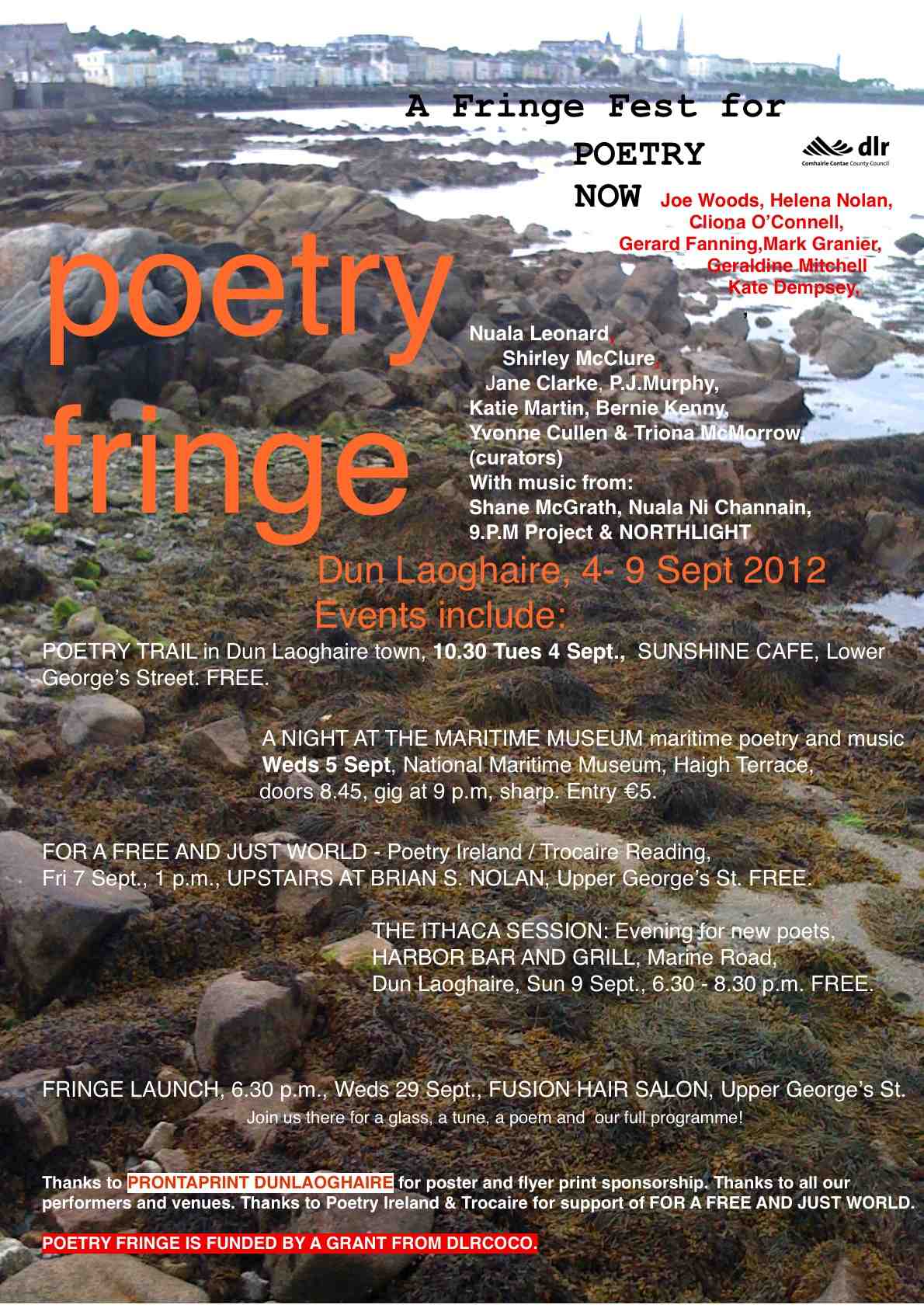
The winner will be announced this weekend at the Poetry Now Festival. Kingston Hotel, Sunday 9th September at 4pm. Entry €5.
Hello Noel and welcome my blog. How did you first get into poetry?
When I was in first year in
secondary school, our English teacher asked us to write a poem. (He was
probably after an easy afternoon!) I wrote something called 'In the City at Night' which was a bleak
portrait of Dublin in the small hours. Other kids wrote poems about hating
cabbage and the like. My teacher liked my piece so much he put it in the school
magazine. I remember the sense of excitement and my hope that a friend's sister
might see it. I don't know if she ever did but it was the first spark of
excitement about what you could do with language broken up into lines. (I saw
it again recently and I have to say it was pretty good for a 13 year old).
I enjoyed poetry in school after
that, but couldn't reproduce the magic of writing poems. Much later, in my
final year we studied Thomas Kinsella's 'Mirror in February' and it really had a powerful impact.
It was a poem written by a poet who was still alive (the only one of the
syllabus at the time) and again I was struck by how much you could say – and
convey emotionally - in such a short space.
Despite this interest, in the
end, I choose to study Natural Sciences at university, majoring in Experimental
Physics. I still kept up an interest in poetry though, reading almost
exclusively 20th Century poetry (recommended by friends in English) such as
e.e. cummins, Wallace Stevens, Eliot and so on. At this point, I still assumed
my future was in physics and I graduated with a first and looked into doing
PhDs at various colleges in the UK. I decided though to take a year out and we
all know that that can be fatal to your future studies! In truth, I didn't
particularly like lab work and it precipitated something of a crisis and the
way I found to deal with that was to try write poetry. This was around late
1993. My first stuff was all flow of consciousness, impressionistic musings and
pretty awful to boot - thankfully now lost - but I remember encountering Seamus
Heaney's collection Seeing Things around that time and decided to try
write 'a bit like him'.
I went to Bewley's Cafe on Grafton Street with the sole
purpose of writing a more formal type of poem. I managed to write a piece
called 'Mama's Dance' (which was a
play on Theodore Roethke's 'Papa's Waltz')
and recognised that something had clicked in my writing. I started doing it
with more intent after this breakthrough and published my first poem in Poetry
Ireland Review about 18 months later in autumn 1995. So I guess the first
poem I wrote in school was a seed and that evening in Bewley's was a turning
point.
How do you think your Science
background influences your writing? Both subject matter and the way you write?
Well, that first published poem was called 'Apple' and was a piece about Isaac Newton so
from the beginning I was drawing on science. I should say, I was a very
dedicated physics student and loved the subject - and science in general - so
it seemed natural to try write about that, among other things. As well as
Newton, I wrote pieces about Galileo's discovery of the moons of Jupiter and a
dramatic monologue by an unnamed woman (in my mind, a housekeeper) about
Einstein as a child ('Einstein's Compass').
The strange thing, though, is that I
moved away from physics as subject matter and started a series of poems about
insects (bees, wasps, ants and so on) as well as geology, palaeontology,
anthropology and even mathematics. There were also, of course, poems about more
emotionally direct material such as family, lovers and loss etc. It wasn't
really clear at this point what I was trying to do, but as the poems accumulated,
I recognised that a pattern was emerging with the science poems acting as a
kind of grand backdrop to the smaller, more personal human dramas. In a sense,
the book was like life played out against the epic scale and timeframe of
nature and the fleeting nature of life positioned beside or, perhaps, against
this.
As to how my background in science affects the way
I write, that is a harder question to answer. Someone asked me recently why as
a 'physicist' (I pointed out a very much lapsed one!) I wasn't more interested
in a more formal poetics. By this they meant, I think, why I didn't writing in
fixed forms such as sonnets, villanelles, sestinas and so on; they thought that
would appeal to someone with a mathematical slant. To be honest, I've never
been terribly interested in these forms. To go back to the evening in Bewley's,
I think I realised that 'form' wasn't the same thing as conformity or whatever
other notions I was carrying around with me. So, let's say, shape and some kind
of formal design entered my work then.
At the same time, I'm not that
interested in language as a puzzle game in the way that certain writers
approach it (I'm thinking of someone like Paul Muldoon who does that
brilliantly). Perhaps, having studied the biggest 'puzzle-game' we know in
science, I sought out poetry to sustain a part of me that also needed to
express experience and emotion and not to be locked down by too many
rules. So there is - I think at least - a formal quality in what I write
which perhaps reflects my background in science, but I'm not what you'd call a
formalist per se. It's as the poem requires! That said, I really do
admire those poets who write in fixed forms and make them seem organic.
Your first book was two novellas. Tell
me about that.
I had my novellas
The Return Journey & Our Friends
Electric accepted for publication with
Bluechrome but they went bust just before they published it. I was disappointed
at the time but in retrospect, if they’d gone bust after publication, it would
have been worse. Adele Ward who published with Bluechrome then joined forces
with Mike Fortune-Wood (who had previously managed the Cinnamon Press) and
together they started
Ward Wood in summer 2010.
So I sent them my novellas in
September 2010 and they were published in February 2011. I noticed that they also
publish poetry so I sent them my collection,
In the Library of Lost Objects and that was published in June 2011.
Why did you choose Ward Wood?
Well, it’s hard to get a publisher to
begin with and while I had one offer by then, I would’ve had to have waited
over 2 years for publication. I heard about Ward Wood at this point and they seemed
like a fresh new press. They took the collection on straight away. Also as I
was only the 3rd person on their list so I felt our relationship was
more personal. That’s since proved to be the case.
How did you get your first collection
ready for publication?
I had been working towards that
collection for some time. The sensibility of the book was formed in 2001 when I
was 30. I did a Masters in Creative Writing in Galway with the idea of
finishing. In 2005, I thought I had the manuscript ready and I sent it out. In
hindsight, I sent out too soon.
So I started culling poems. I became
ruthless. The more I cut, the better the reception from publishers, although I
was still getting rejections. But now they were saying, “Come back in a year.”
I went back to a folder of poems that
I hadn’t quite managed to finish and realised most needed to be just edited
back. Some important poems came out of that process, which I added to the 30
poems that remained, so these 40 pieces were my finished collection. By this
time, I had been honing the book for a long time, but I realised then that it
was finished – which was a massive relief! My editor later did a close edit of
the poems. She’s a very good close reader of material and helped with nuance and
detail in several pieces, as well as punctuation and occasional lapses into
prose. But the initial list of 40 she saw, were the final 40. She now has some
readers who you can send work-in-progress to and get feedback at important
moments. That’s been very helpful with the collection I’m currently working on.
Do they give different responses?
Sometimes the advice converges,
sometimes it diverges completely. And I’m there thinking, which way do I go? I
have made changes based on some comments, but not all. Sometimes I changed
things and then just changed them back. I have more confidence now with one
book published and sometimes you’ve got to trust your own ear and instincts!
The period when I was getting
rejection letters for the first collection was very difficult. You begin to
wonder if the collection will ever come out. And then even getting a publisher
isn’t the end. Beyond that, it’s how people respond. Another thing I hadn’t
expected was how it affected people who don’t read poetry, how it found its way
to them. I was trying to create a narrative with the ordering of the poems but
many people told me they dipped in and out rather than reading the whole thing
from start to finish. You have to accept that people will cherry pick poems, which
is fine, but I did spend a lot of time sequencing the book to create a kind of
emotional arc through the collection. I hope some people, at least, have
noticed that!
You had some good reviews
The Poetry Book Society review was a great start and drew some
magazine editor’s eyes to the book, particularly in the UK. There were also reviews
in
Poetry Ireland Review, Orbis and
in
Magma. One response talked about how one
piece (‘
Baltic Amber’) pulled a lot
of threads together to give the book cohesion. I wouldn’t have recognised it in
those terms – as being so central to the collection, I mean - but I did place
it near the end of the book and poems there are intended to complete the
narrative I mentioned. Even doing things like this interview make you think it
through more. Speaking about the poems can be sometimes harder than writing
them, but it’s very useful I find. It’s like holding the work up to a mirror
and sometimes being surprised by it and how others see it.
And then you were nominated for the
Strong Award for a first collection.
Yes. It’s great. These awards help
draw attention to your work. Ward Wood is a London-based publisher and the book
is in some shops there. Hodges & Figges and Dubray Books both took it on
the basis of the nomination. That was very lucky. There are fewer bookshops now
that stock debut collections. But credit should also go to Book Upstairs who
carried the book from the beginning and are great champions of new Irish
writing.
How far along is your second collection?
It’s called On Light And Carbon and again I’ve been combining science poems and
personal poems. I’ve been playing with the different meanings of light and
carbon. It’s nearly there in a rough draft. I’ve been editing seriously for the
last couple of months. It’s coming together more quickly than I expected. It
was written in a much more contracted time frame than the first collection;I
was also lucky enough to get an arts council grant so I could devote a lot more
time to writing this year.
I’ve also used a slightly different
approach with this one by trying to write a first draft of each poem as quickly
as possible to try maintain the movement of intent and emotion. That said, I’ve
probably only used every other poem I’ve written for the book. The general idea
for this collection is to explore the physics of light and waves, both as literal
ideas and as metaphors.
There’s your Physics background coming
through
Even though I didn’t go on in physics,
I have a passion for it and science in general so it informs how I see the
world. I try to make such poems both readable and intelligible for
non-scientists. You don’t have to be a scientist to write about science, or I
should add, to understand them. For example, in a poem called Harmonic
Resonance, I try to explain the concept within the poem, rather than adding it
as a footnote. But there has to be more to the poem. The physics was a starting
point but it turned into an elegy to my friend’s father, who was a very fine
pianist. In the end, I think a poem has to be more than an idea.
Is your first collection available in
ebook format?
Yes, it’s coming out on Kindle. It’s
much harder to layout poetry in this form due to line breaks and stanza
patterns and so on but my publisher has found a way to do it and we have to
cover that base. E-books look like they are now beginning to outsell paper
books. And poetry books are sold in fewer and fewer places now so maybe it will
help to make the work more available.
Ward Wood also encourage their authors
to have a good online presence. Facebook, in particular, is a nice way of meeting
poets. I’ve met some in real life who I first encountered online. I’ve also put
some of my poems in various places on the web. The conundrum is if lots of the poems
are available, then large chunks of the collection may have been read already. So
there’s less reason to buy the book. It’s a balance really.
Do you have any advice for new writers?
In every creative writing class I’ve
taught, there was at least one student with great talent. So talent isn’t as
rare as you’d think. What’s really important is how hard you work after that. You
should also read and learn as much as you can to refine your knowledge of the
form. I’d also say, don’t be afraid to
write badly, just write. Some poems will come out better than others and that’s
fine. I’ve been writing for nearly twenty years and that’s still true. Some of
the poems in my second collection were orphaned from the first, and others – in
revised form – go back to my first year’s writing. The difference now is that I
can make more of them with experience. Don’t be too precious about it either,
nor think that rewriting is cheating as some new writers feel. Also, don’t
always wait for lightening to strike. Meet the muse halfway! And one final word
– and perhaps the most important – enjoy it.
Thanks very much Noel and good luck
with the Strong Award
Noel Duffy was born in Dublin in 1971
and studied Experimental Physics at Trinity College, Dublin, before turning his
hand to writing. He co-edited (with Theo Dorgan) Watching the River Flow: A
Century in Irish Poetry (Poetry Ireland, 1999) and was the winner in 2003
of the START Chapbook Prize for his collection, The Silence After.
His work has been published widely in
Ireland and abroad, including Poetry Ireland Review, The Dublin Review, The
Cuirt Journal and De Brakke Hond: Special Irish Issue (Belgium). His
collection of two novellas The Return Journey & Our Friends Electric was
published by Ward Wood in early 2011, followed by his debut poetry collection In
the Library of Lost Objects, again published by Ward Wood. It been
shortlisted for the 2012 Strong Award for Best First Collection by an Irish
author.